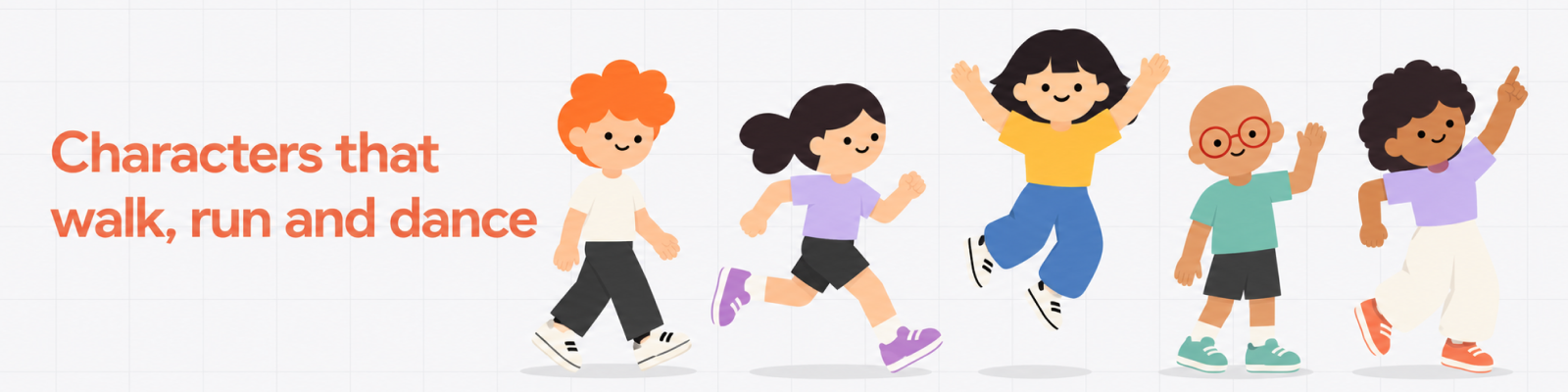
Kivot gives you a cast of flat-vector characters and the tools to make one your own, then hands the result to your scene as ordinary Lottie: animated shape layers, round-capped strokes and filled paths. No expressions, no images, no runtime library, so it plays anywhere Lottie plays.
Build, Look, Move
Build is where you start. Nine proportion sliders (head, torso height and width, arm and leg length, limb thickness, hands and feet, eye size and spacing) reshape the rig itself, previewed on a grey mannequin with the part you are changing lit red.
Look dresses it. Every part is a picture, not a word: hair, eyes, mouth, top, bottom, shoes, extras, build and limbs, each option drawn on the mannequin in your current colours. Eleven colour roles, from skin to soles to the cap frames.
Move picks the motion. Idle, Walk, Run, Jump, Wave, Cheer, Dance and Still, each shown as a small animated mannequin card, with seventeen walk personalities (Natural, Stomp, Bouncy, Heavy, Sneak, Strut, Sway, Robot, Tiptoe, March, Waddle, Scurry, Slouch, Skip, Zombie, Catwalk, Limp), three runs (Sprint, Jog, Ninja) and twelve dance moves (Groove, Twist, Hop, Shuffle, Slow sway, Disco, Raise the roof, Robot, Headbang, Two-step, Shimmy, Star jump). Speed, energy and bounce sliders run to 300% when you want it big.
Any angle
Front, three-quarter, profile or back, or dial any angle with the Turn slider. The torso thins, the arms and legs swap depth, the face slides round the head and the backpack keeps its place, all in plain shapes. Walks left or right.
The cast
Nine characters hang out under the preview. Hover one and they step forward and do their own thing; tap to start from them. Shuffle rolls a new one from the parts you have not locked.
Two ways into your scene
Loop cycle inserts the chosen motion as a seamless loop. Cycles are sampled every frame and then reduced to the fewest keyframes that reproduce the motion within half a pixel, with measured easing on every key, so a walk is a fraction of the size of a baked export.
Rig only inserts the character in its resting pose with no keyframes at all, cut at the joints and hung from fifteen null controllers: a root at the pelvis, a chest, a head, and shoulder, elbow, wrist, hip, knee and ankle for each side. Rotate a null and the limb swings from that joint, move it and everything below comes along, scale it and the bone stretches. Pose it, key it, make it yours.
How the motion is built
Walk and run cycles are authored as key poses on the classic breakdowns, interpolated with continuous velocity through every contact. The planted foot travels under the body at constant speed and the swing foot follows a matching arc, with knees solved by two-bone IK, so feet never slide, float or sink. Arms lag the legs by a beat, the head lags the torso, hair carries follow-through.
Requests and ideas are welcome from the bulb button inside the plugin.